Prop-firm and capital
A prop-firm evaluation is not an average-return problem — it is a path problem. You do not need to be profitable on average; you need to hit a profit target without ever breaching a drawdown limit along the way. A strategy with a real edge can still fail most challenges if it is sized too aggressively, because a single bad stretch trips a hard limit before the edge has time to compound. This chapter is the math of surviving that path: sizing to a drawdown budget, and Monte-Carlo pass rates over resampled histories.
Strip away the jargon and a funded-account evaluation is a board game with one brutal rule: reach the finish square before you ever land on a trap square. The finish is a profit target; the traps are a daily-loss line and a total-loss line. It does not matter that your dice are loaded in your favour on average — one unlucky run of rolls onto a trap ends the game, and the average never gets to play out. So the real question is never “is my strategy profitable?” It is “sized thisway, how often does a real run of my P&L reach the target before it hits a trap?” That is a path question, and the only honest way to answer a path question is to simulate the paths.
What a prop-firm evaluation demands#
Funded-account programs let you trade the firm's capital after you pass an evaluation. Every evaluation is a set of hard constraints, all in account dollars:
- Profit target — reach dollars (possibly across multiple phases) to pass.
- Max loss — total equity may never fall dollars below the starting balance. Breach it and the account is gone.
- Daily loss — you may never lose more than dollars in a single day.
- Minimum days — a floor on active trading days before a phase can be marked passed, so you can't pass on one lucky trade.
ek.challenge.ChallengeRules encodes exactly these, and edgekit ships three presets that mirror the published rules of real firms:
ChallengeRules(account, phase_targets: list[float], daily_loss,
max_loss, min_days=4)| Preset | phase_targets | daily_loss | max_loss | min_days |
|---|---|---|---|---|
FTMO_1STEP | [10_000] | 5_000 | 10_000 | 4 |
CFT_2PHASE | [8_000, 5_000] | 5_000 | 10_000 | 4 |
BRIGHTFUNDED | [8_000, 5_000] | 5_000 | 10_000 | 3 |
All three are $100k accounts. A two-element phase_targets means a two-phase evaluation — you must clear each phase in turn.
Sizing to a drawdown budget#
Sizing is the single lever that decides whether an edge survives the path. Bet too little and you never reach the target inside the day limit; bet too much and a routine drawdown trips the max-loss rule. The disciplined approach is to size so that the strategy's historical worst drawdown exactly fills a chosen budget, then trade that size. ek.sizing.size_to_dddoes this: it turns a daily-R stream into a dollar-per-R scalar such that the sized curve's max drawdown equals the budget.
from edgekit import sizing

res = sizing.size_to_dd(daily_r, dd_budget=0.08, account=100_000, daily_cap=0.045)
sized = res["sized"]          # dollar P&L per day; historical max DD == 8% of account
res["dollar_per_r"]           # the applied scalar
res["binding"] # "max-dd" or "daily" -- which limit set the sizesize_to_dd reproduces the observed worst drawdown exactly — but live drawdown almost always runs deeper than the single lucky history. Size against a budget tighterthan the firm's limit (an 8% internal budget under a 10% hard limit), leaving headroom for the drawdown you haven't seen yet. Better still, size against a bootstrapped worst-case drawdown, which is what the Monte-Carlo below effectively measures.Monte-Carlo pass rate#
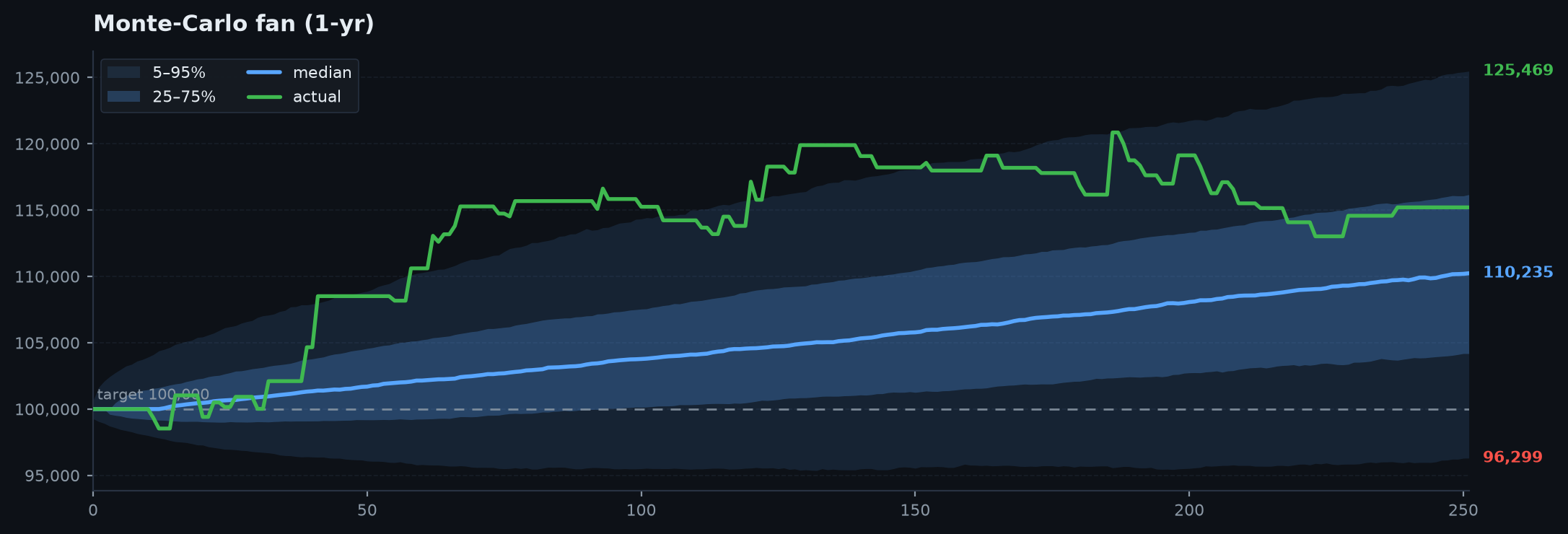
Because passing is a path problem, the only honest estimate of your odds is Monte-Carlo over many resampled histories. ek.challenge.simulateblock-bootstraps the sized daily-P&L stream into thousands of alternate paths and returns the fraction that clear every phase without breaching a limit. It uses a blockbootstrap, not i.i.d. resampling, so losing streaks stay intact — a strategy's clustered losses are precisely what trip a daily limit, and shuffling them away would flatter the pass rate.
simulate(daily_pnl_dollars, rules, n=12000, rng=None,
block=5, phase_days=400) -> floatimport numpy as np
from edgekit import challenge, sizing
sized = sizing.size_to_dd(daily_r, dd_budget=0.08, account=100_000)["sized"]
rng = np.random.default_rng(0)
rate = challenge.simulate(sized, challenge.FTMO_1STEP, n=12000, rng=rng)
print(f"pass rate = {rate:.1%}")size_to_dd first, then simulate.BRIGHTFUNDED is a $100k account with phase targets , a $5,000 daily-loss line, a $10,000 max-loss line, and a 3-day minimum. First you size. The book's historical worst drawdown is ; against an 8% internal budget (deliberately under the 10% hard limit) size_to_dd solves and reports binding = "max-dd" — the drawdown budget, not the daily cap, set your size. Then you simulate: block-bootstrap that sized dollar stream 12,000 times through both phases. Say it returns a pass rate of with a median 41 trading days to clear both phases. Now you can decide with numbers rather than nerve: roughly two-in-three odds, about six weeks of capital tied up. Halve the size and the pass rate might edge toward 74%, but the clock stretches past the phase-day budget — the exact trade-off the next section makes explicit.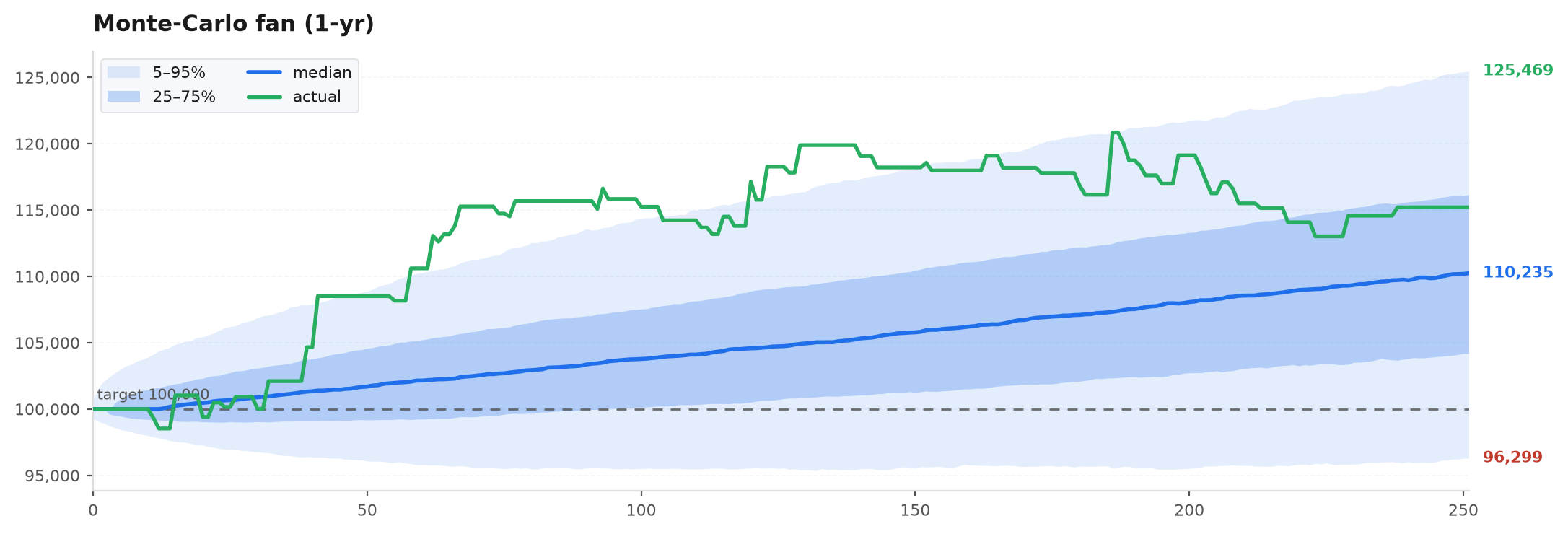
How long a pass takes#
Pass rate alone hides a cost: a program that passes 80% of the time but takes six months of trading may not be worth the capital tie-up. ek.challenge.days_to_pass returns the distribution of days-to-pass over the paths that succeed.
d = challenge.days_to_pass(sized, challenge.CFT_2PHASE)
print(d["median"], d["p25"], d["p75"], d["pass_rate"])   # typical + spread of days, and the rate
The aggression / survival trade-off#
Sizing up shortens the median days-to-pass — you reach the target faster — but it also fattens the left tail of the equity distribution, so more paths breach a limit first. There is an interior optimum: past a point, extra size lowers the pass rate. Sweep the drawdown budget and watch the pass rate rise, peak, and fall.
for dd in (0.04, 0.06, 0.08, 0.10):
    sized = sizing.size_to_dd(daily_r, dd_budget=dd, account=100_000)["sized"]
    rate = challenge.simulate(sized, challenge.FTMO_1STEP, n=12000,
                              rng=np.random.default_rng(0))
    print(f"dd_budget={dd:.0%}  pass rate={rate:.1%}")
At the desk. The sweep prints something like 4% → 52%, 6% → 64%, 8% → 68%, 10% → 61%. Read the shape, not the rows: the pass rate climbs as you dare more size, peaks near the 8% budget, then fallsat 10% — even though 10% is the firm's own hard limit. Sizing to the very edge of the rule is worse than sizing just inside it, because the extra size fattens the left tail faster than it speeds you to the target: you trip the daily line on a bad cluster before the edge gets to compound. The survival-optimal budget sits comfortably below the limit, which is the whole counter-intuitive point of funded-account sizing.
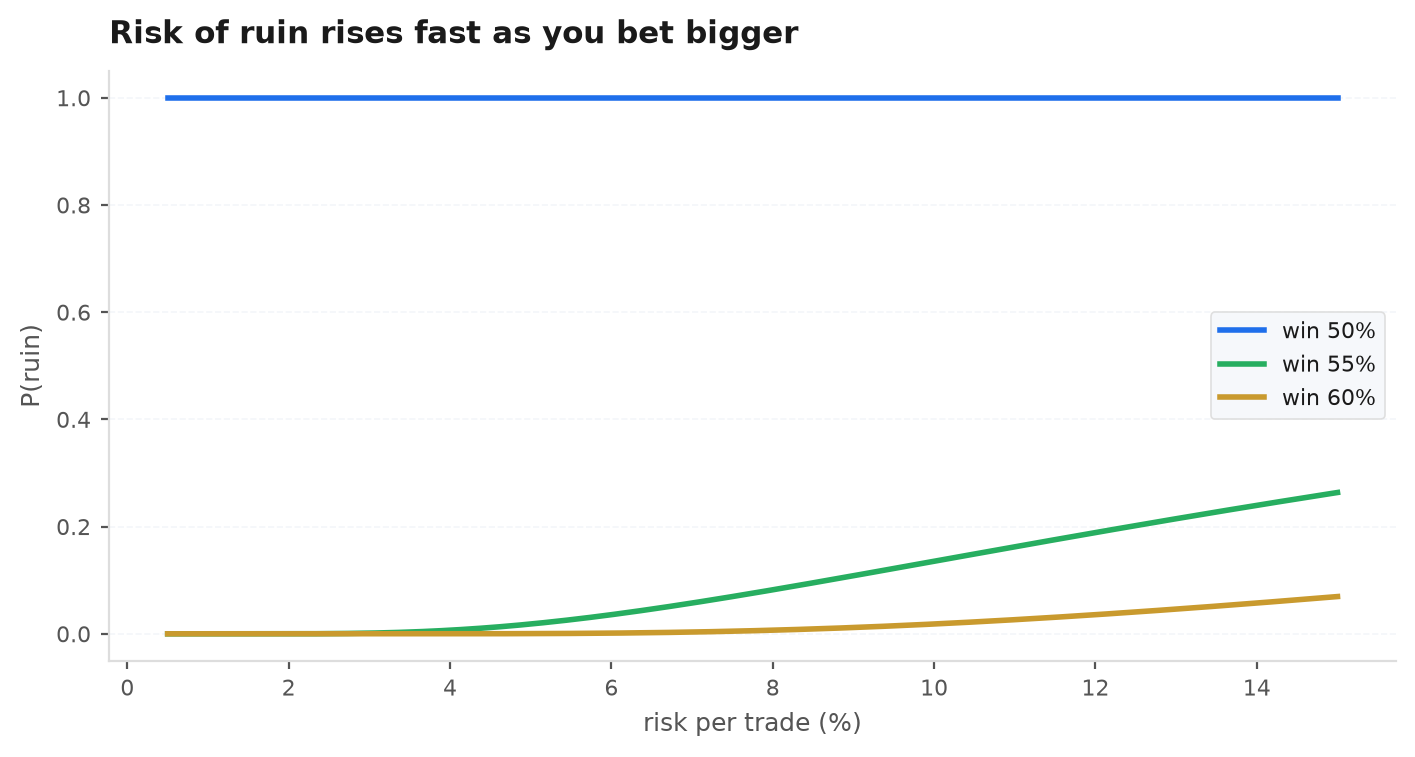
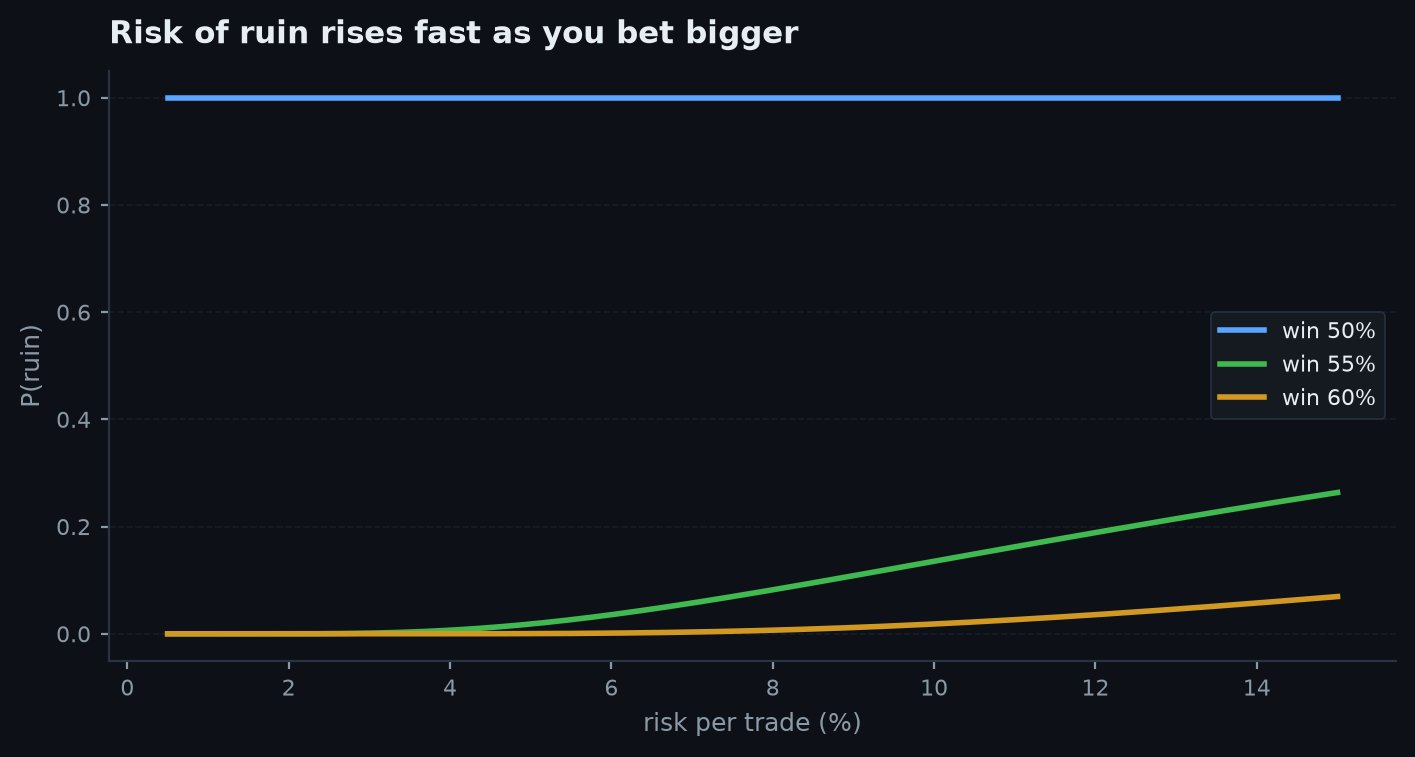
This is the same idea as risk of ruin from position sizing: beyond the growth-optimal fraction, each extra unit of size raises the probability of hitting an absorbing barrier faster than it raises expected profit. In a prop evaluation the max-loss rule is the absorbing barrier, and it is much closer than a blown account — which is why funded-account sizing is almost always well below what a pure-growth calculation would suggest.
Next: you have an edge, a book, a size, and a pass rate — now close the loop from research to a live account in Backtest to live.