Geometric probability
When outcomes are uniform over a region, probability is literally area: the chance of an event is the area of the favourable region divided by the area of the whole. That one idea turns word problems into pictures — two people trying to meet become a band across a square, a broken stick becomes a triangle inside a triangle, a random chord becomes a point in a disk. This chapter teaches you to seeprobability: the meeting problem, the broken stick, points on a circle, Buffon’s needle, and — as the centrepiece warning — Bertrand’s paradox, where three impeccable readings of “uniformly at random” give three different answers.
Every problem here yields to the same three moves. Draw the sample space: if the randomness is two uniform numbers, the sample space is a square; three numbers, a cube; a point on a circle, the circle itself. Shadethe event: translate the words (“they meet”, “the pieces form a triangle”) into inequalities and shade where they hold. Measure: the probability is the shaded fraction — length, area, or volume as the dimension demands. The hard step is never the integral; it is the translation from words to region. And the deepest lesson of the chapter is that the firstmove already commits you to a model: “uniform” is a choice of sample space, and different choices give different answers to the same-sounding question.
Probability as area#
Let be a region of finite volume and suppose a point is drawn uniformly from : the density is constant, . Then for any event ,
This is the continuous twin of the counting formula from counting & combinatorics — equally likely outcomes, with volume replacing cardinality. Two independent uniforms are exactly a uniform point in the unit square, because the joint density is flat (joint distributions). So any question about two independent uniforms is a question about the area of a region in a square, and the entire method is: find the region, find its area. Complements help constantly — awkward regions often have simple complements (triangles in the corners, as the meeting problem is about to show).
The meeting problem#
Two people agree to meet between noon and 1pm. Each arrives at a time uniform on minutes, independently, and each waits 10 minutes before giving up. What is the probability they meet?
Let and be the arrival times. They meet exactly when . Rescale to the unit square (, ): the sample space is and the event is the diagonal band . The band is ugly to integrate directly but its complement is two clean right triangles — the corners where one person arrives more than 10 minutes after the other. Each triangle has legs , so
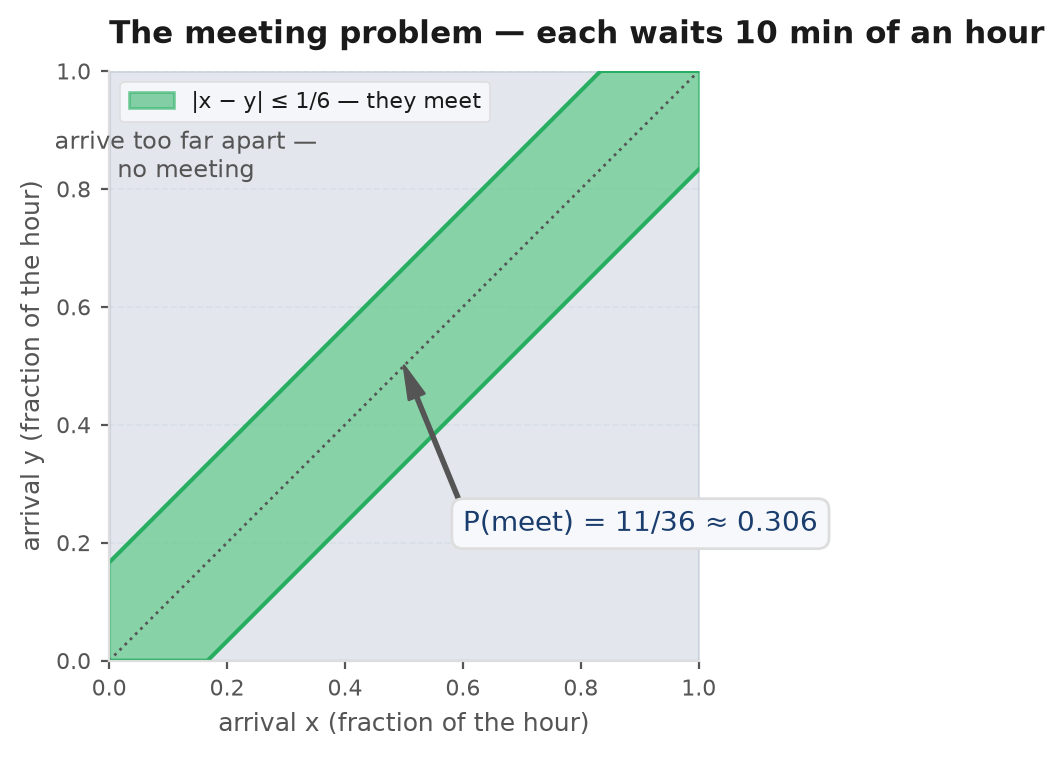
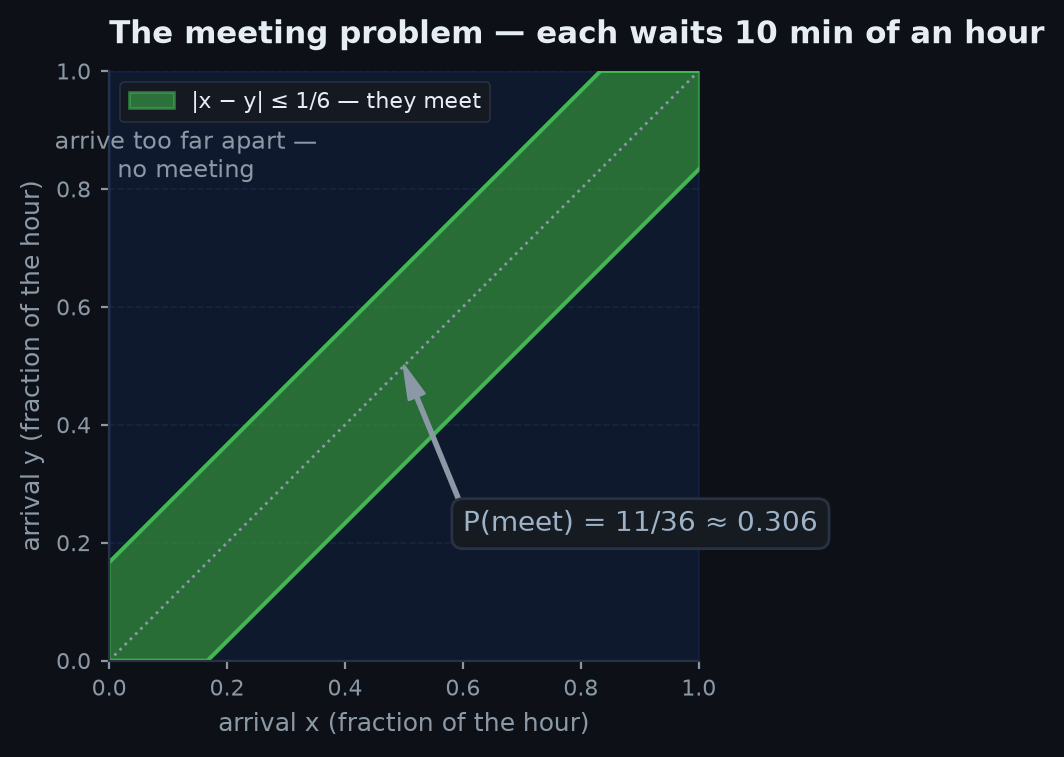
With window and wait time , the same picture gives
Check the limits: gives probability 0 (exact simultaneity has zero area — a line has no area in the square), and gives 1 (whoever comes first waits out the whole hour). The formula is also concave in : the first 10 minutes of patience buys , the next 10 only raises it to , an increment of 0.25 — diminishing returns, visible in the picture as the band eating progressively smaller slices of the corner triangles. Reading limiting cases off the picture is the fastest error check in this whole subject.
The broken stick#
Break a stick of length 1 at two points chosen independently and uniformly. What is the probability the three pieces can form a triangle?
Let the break points be , a uniform point in the unit square. On the half where — call them — the pieces are , , and . Three lengths form a triangle iff every piece is shorter than the sum of the other two, i.e. iff every piece is shorter than (a piece of length is at least the other two combined). The three conditions are
Inside the triangle (area ), the three inequalities cut out the smaller triangle with vertices , , — the medial triangle, whose sides are half those of the big one, so its area is a quarter of , namely . By symmetry the case contributes another :
The same picture lives naturally in the simplex: the piece lengths are a uniform point in the triangle , and “all pieces ” is the central medial triangle — one of four congruent copies, hence at a glance. The three corner triangles are the three ways one piece can hog more than half the stick.
Now break the stick once, uniformly; then break the longerpiece at a uniform point. Same words — “two random breaks” — different mechanism, and the answer changes: , not (worked as Problem 3 below). Conditioning the second break to land on the longer piece removes the worst failure mode, where both breaks fall on the same side and leave a monster piece. The lesson previews Bertrand’s paradox: a random procedure is not defined until you state the mechanism. The same trap is sprung in several classics in probability brainteasers.
Points on a circle: the semicircle problem#
Drop points independently and uniformly on a circle. What is the probability that all of them lie in some semicircle?
For each point , let be the event that the semicircle starting at point and running clockwise contains all points — point is the “leading edge” of the pack. Two facts:
- The events are disjoint (for ): if all points fit in a semicircle, exactly one of them is the clockwise-first — with probability 1 there are no ties — so at most one occurs, and “all in some semicircle” is precisely .
- Each has probability : given where point landed, each of the other points independently falls in its clockwise semicircle with probability .
Additivity over the disjoint union — no inclusion–exclusion corrections needed — gives
Check small cases: gives 1 (two points always share a semicircle), gives , gives . The trick — use symmetry to make the “or” disjoint, then add — is a signature move of symmetry & exchangeability: all points are exchangeable, so every candidate leader contributes the same probability, and the union costs a plain factor of .
The complementary view is through arc gaps: points cut the circle into arcs, and “all in some semicircle” says exactly that the largest gap exceeds half the circumference. The joint law of those gaps is the spacings distribution of uniform order statistics bent into a loop — exchangeable, each gap marginally — developed in order statistics. Many circle problems are secretly spacings problems: the semicircle question, the acute-triangle question (Problem 4), and coverage problems all ask about maxima or minima of the gaps.
Buffon’s needle#
Rule the floor with parallel lines a distance apart and drop a needle of length at random. The needle’s position is captured by two coordinates: the distance from its centre to the nearest line, and its angle to the lines, independent. The needle crosses a line iff its half-projection reaches the line: . Shade that region in the rectangle — the area under half a sine arch — and measure:
using . With the probability is — and appearing in a floor-and-needle experiment means you can estimate it: throw needles, count crossings, and invert to .
Buffon’s needle is historically the first Monte Carlo method — and a case study in why estimator design matters. with , and the delta method (estimators & sampling) gives . The rate means every additional decimal digit of costs 100 times more throws: two decimals need , six decimals . Reports of needle experiments “hitting to several digits” in a few thousand throws (Lazzarini’s famous 355/113) are stopping-time cherry-picks, not statistical miracles. The general theory — when Monte Carlo is the right tool, and how variance reduction rescues estimators like this — is Monte Carlo methods.
Bertrand’s chord paradox: “uniform” is a decision#
Draw a “random chord” of a unit circle. What is the probability it is longer than , the side of the inscribed equilateral triangle? Bertrand (1889) offered three impeccable answers:
- Random endpoints: pick two independent uniform points on the circle. Fix the first at a triangle vertex; the chord beats iff the second endpoint lands on the far arc between the other two vertices — one third of the circle. .
- Random radius: pick a direction uniformly, then slide the chord perpendicular to it with midpoint distance uniform on . The chord beats iff its midpoint lies within distance of the centre — half the radius. .
- Random midpoint: pick the chord’s midpoint uniformly in the disk. The chord beats iff the midpoint falls in the concentric disk of radius , whose area is of the whole. .
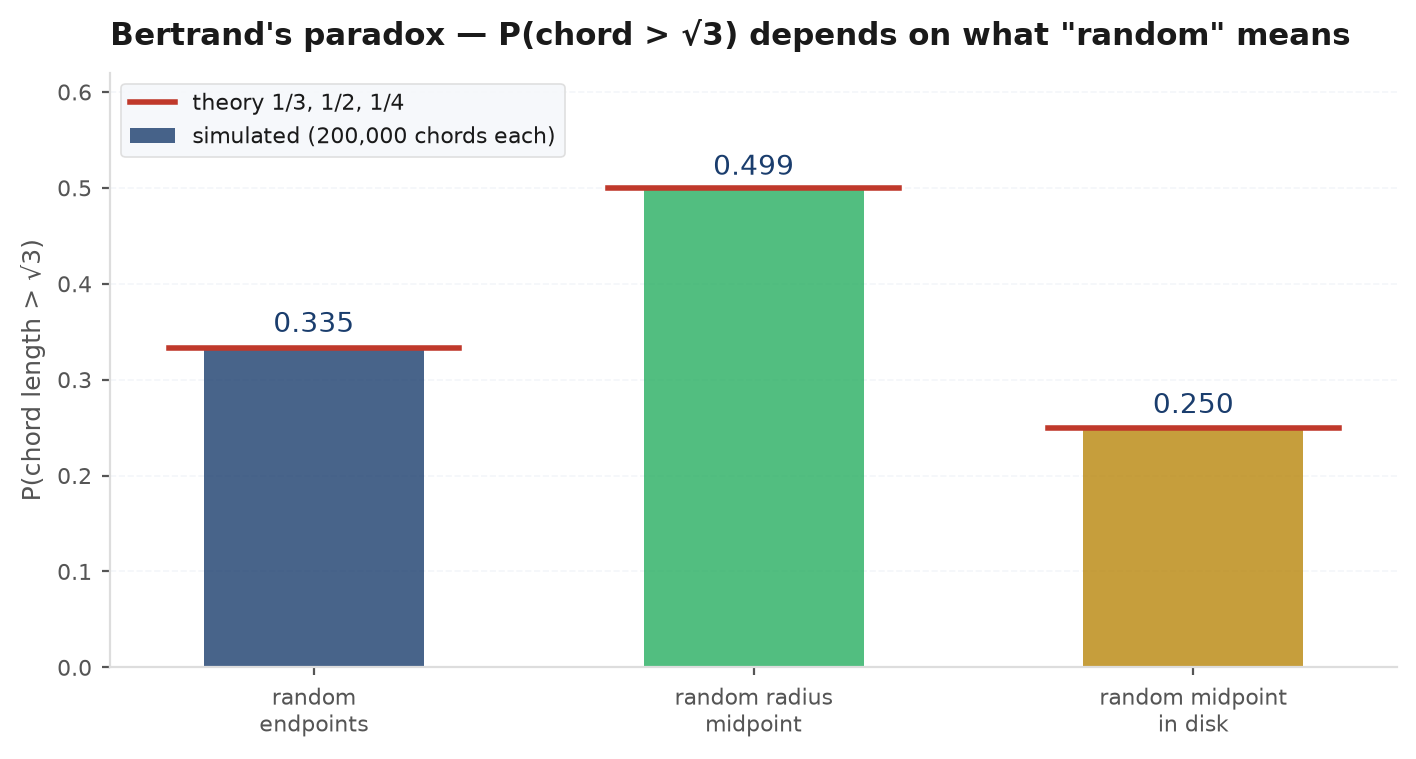
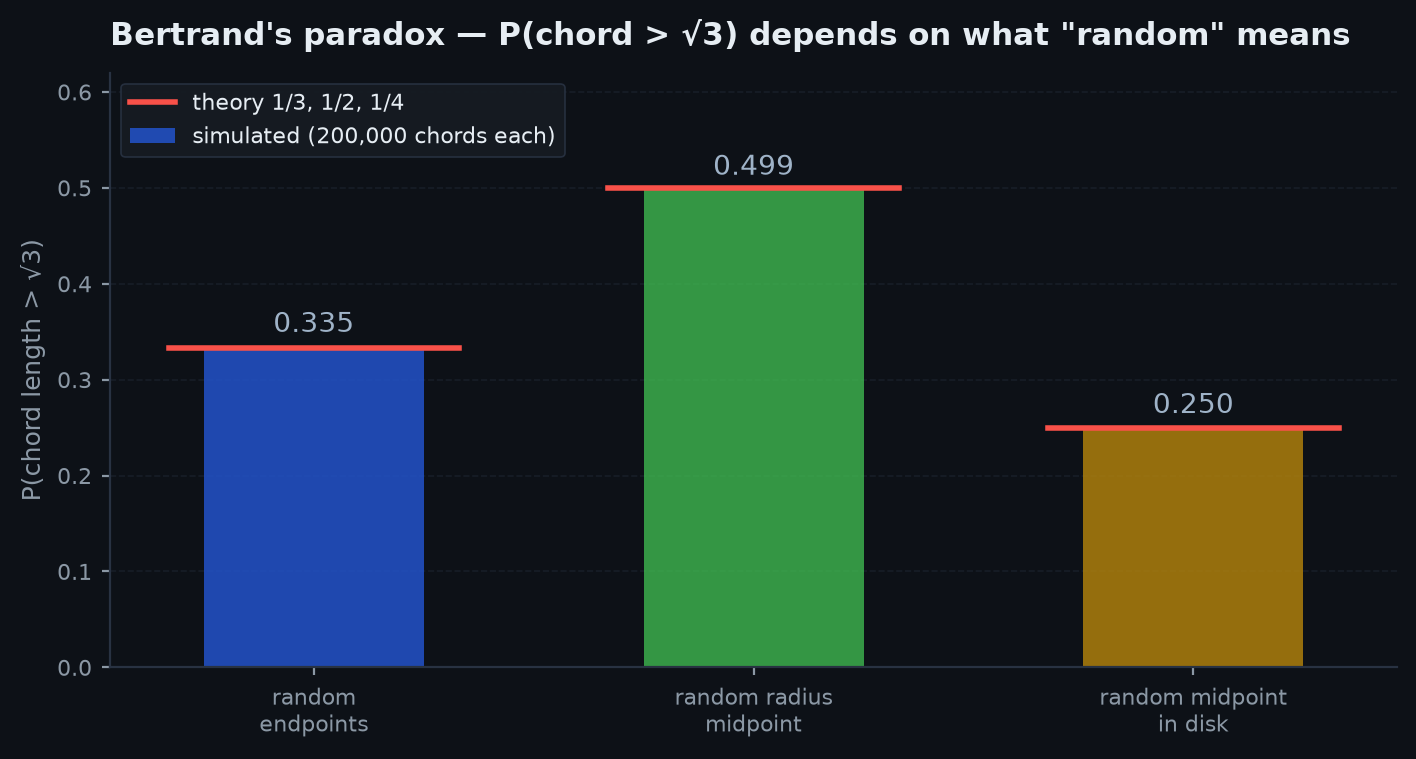
None of the three calculations contains an error. The question does. “A random chord” names an outcome but not a mechanism, and the three mechanisms put different measures on the same set of chords: uniform endpoints crowd midpoints near the rim (long chords rare), uniform-in-disk midpoints crowd the area near the rim too but differently, and the radius model spreads midpoints evenly along each spoke. “Uniformly at random” is a modeling decision, not a fact of nature. It is the continuous twin of Monty Hall’s protocol-dependence in axioms, conditioning & Bayes: there the answer hinged on the host’s information-generating mechanism, here it hinges on the chord-generating mechanism, and in both cases the honest first sentence of any solution is a statement of the mechanism. In practice the ambiguity dissolves the moment the physical process is specified — a straw dropped from far above the circle realises the radius model, and demanding invariance under rotations, translations and scalings singles out (Jaynes’ resolution) — but the resolution is extra physics, not extra mathematics.
Distance problems: how far apart are two uniform points?#
Drop independently. The expected distance is an area-weighted average over the unit square. Split the square along the diagonal and use symmetry:
A picture-first alternative: by the tail formula, and is exactly the two corner triangles from the meeting problem, so — the meeting problem and the distance problem are the same square read two ways. Instructive companions: the expected maximum of the two is and the minimum (order statistics), so the average gap between the pair equals the average length of each of the three segments they cut — the spacings symmetry again.
The unit square is not just a puzzle arena; it is the natural habitat of copulas. Any pair of continuous returns can be transformed to uniform margins, and their joint law becomes a density on the square — independence is the flat square, co-crashing assets pile mass in the corner, and reading those pictures is the business of copulas & dependence. Geometric probability is the skill of computing with such pictures. The same reasoning prices operational overlaps: two order flows each active for a fraction of a window, a fill that happens only if your resting quote and the incoming burst overlap in time — that is the meeting problem verbatim, and is a first estimate of the overlap probability. When a joint event is “two independent timers landing close enough”, draw the square before touching an integral.
import numpy as np

rng = np.random.default_rng(17)
n = 1_000_000

# Meeting problem: arrivals uniform on [0, 60], each waits 10 minutes.
x = rng.uniform(0, 60, n)
y = rng.uniform(0, 60, n)
meet = np.abs(x - y) <= 10
print(f"P(meet)      = {meet.mean():.4f}   (theory 11/36 = {11/36:.4f})")

# Broken stick: two uniform breaks; triangle iff every piece < 1/2.
u = rng.uniform(0, 1, n)
v = rng.uniform(0, 1, n)
lo, hi = np.minimum(u, v), np.maximum(u, v)
pieces = np.stack([lo, hi - lo, 1 - hi])          # the three piece lengths
triangle = (pieces < 0.5).all(axis=0)
print(f"P(triangle)  = {triangle.mean():.4f}   (theory 1/4   = 0.2500)")

# Bonus: expected distance between two uniform points on [0, 1].
print(f"E|X - Y|     = {np.abs(u - v).mean():.4f}   (theory 1/3   = {1/3:.4f})")
Practice problems#
Five problems that test whether you can make the pictures yourself — each one is a region waiting to be drawn, shaded, and measured.
Two traders agree to sync up during a 60-minute window. A waits 15 minutes, B waits only 5. What is the probability they meet?
Solution. Let be A’s arrival and B’s, uniform on the unit square after dividing by 60. They meet iff neither gives up: if A arrives first () they need ; if B arrives first, . The complement is two unequal corner triangles with legs and :
The band is now asymmetric about the diagonal — wider below, narrower above. Takeaway: asymmetric rules bend the region, not the method; the complement is still two triangles, just with different legs.
A point is uniform in a square. What is the probability it lies closer to the centre than to the nearest edge?
Solution. Take the square , centre at the origin. By symmetry, work in the sector where the nearest edge is (the wedge ) and multiply by 4. There the condition is ; squaring, , i.e. — the inside of a parabola with focus at the centre and directrix on the edge (that is the defining property of a parabola: equidistant from focus and directrix). The parabola meets the wedge boundary where , i.e. . The sector’s favourable area is
and multiplying by 4 sectors then dividing by total area 4 leaves the same number: . Takeaway: equidistance conditions draw conic sections — recognising the parabola turns a two-variable slog into a one-line integral.
Break a unit stick at a uniform point; then break the longer piece at a uniform point. What is the probability the three pieces form a triangle?
Solution. Let the longer piece after the first break have length , which is uniform on with density 2. The short piece is never the obstruction; breaking at works iff both parts are below : , an interval of length , so the conditional probability is . Average over :
Larger than , because aiming the second break at the longer piece forecloses the both-breaks-on-one-side disaster. Takeaway: two verbally identical “random breaks” are different measures on the same simplex — Bertrand’s lesson in one dimension.
Three points are uniform on a circle. What is the probability the triangle they form is acute?
Solution. The inscribed-angle theorem says the angle at vertex is half the arc not containing ; that angle is obtuse iff its arc exceeds a semicircle, which happens iff all three points lie inside the complementary semicircle. So the triangle is obtuse iff all three points fit in some semicircle (right angles have probability 0), and the leading-point formula with gives :
Equivalently, in the arc-gap picture: acute means no gap between consecutive points exceeds half the circle. Takeaway: a geometry question about angles became a probability question about spacings — translating between the two languages is the skill.
Compute for independent , showing every step.
Solution. Split the square along the diagonal; the two halves contribute equally by symmetry:
Cross-check by the tail formula: (the two corner triangles of the meeting picture), so . And by simulation: the code block above prints . Takeaway: one answer, three routes — direct integration, tail integration of a picture, and Monte Carlo — and a result you should simply know: two random points on a ruler sit, on average, a third of the ruler apart.
Next: from continuous regions back to discrete throws — collisions, empty bins, coupon collecting, and the birthday bound that governs hash tables and duplicated backtest seeds alike. Balls, bins & birthdays.